Intermittent Fasting in Perimenopause and Menopause: The Hidden Risk to Bone Health
WHY INTERMITTENT FASTING AND TIME-RESTRICTED EATING IN PERIMENOPAUSE AND MENOPAUSE IS A HIDDEN RISK FOR BONE LOSS — AND WHAT TO DO ABOUT IT
Margaret McNamara | Naturopath & Iridologist | Brisbane Naturopathy & Iridology
This matters enormously for those who practise intermittent fasting or time-restricted eating, and if you're a woman in perimenopause or menopause, it matters even more.
If you wake at 7am but don't consume your first calcium-rich meal until 10am, you've extended an already elevated overnight PTH peak — placing additional strain on your bones at exactly the time they're most vulnerable. And with oestrogen declining, your bones are already under pressure they've never faced before.
Intermittent fasting and time-restricted eating (TRE) have gained enormous popularity, and for good reason. But there is one critical, largely overlooked consequence of delaying your first meal that every woman in perimenopause and menopause needs to understand: the impact on calcium regulation and bone health.
It's not about abandoning the fasting pattern you love. It's about working with your body's own internal rhythms to protect your bones while you do it.
In this article, we explore the science behind calcium regulation, your body's remarkable PTH circadian rhythm, and what you can do, practically and naturally, to support stronger bones, a healthier gut, and long-term vitality through perimenopause, menopause, and beyond.
Understanding the Issue: Your Body's Calcium Regulation System
The Parathyroid Hormone — Your Calcium Alarm System
Parathyroid hormone (PTH) is your body's primary calcium regulator. When blood calcium levels dip, your parathyroid glands secrete PTH almost instantaneously. PTH then works on three fronts: stimulating bone to release stored calcium, directing the kidneys to conserve calcium rather than excrete it, and activating vitamin D to increase calcium absorption in the gut.
This is a brilliant short-term survival mechanism. But when calcium intake is chronically low, PTH remains persistently elevated — a state known as secondary hyperparathyroidism. Over time, this sustained bone resorption can silently deplete bone mineral density, even in women who feel perfectly well.
The Hidden Circadian Rhythm of PTH
Here is where the science becomes truly remarkable. Research published in the Journal of Clinical Endocrinology and Metabolism confirms that PTH follows its own endogenous circadian rhythm. This biological clock runs independently of sleep, meals, posture, or light cycles. PTH peaks in the early hours of the morning (around 1–3am) and again in the late afternoon (around 5pm), with a trough around mid-morning.
The clinical relevance of this rhythm is reflected in how the kidneys handle calcium across the day. When PTH is high overnight, the kidneys work to conserve calcium. When PTH dips in the morning, urinary calcium excretion rises. Disrupting this rhythm, through poor intake timing, chronic deficiency, or hormonal changes, can compound calcium losses over years.
For women in perimenopause and menopause in Queensland and across Australia, where outdoor lifestyles can mask underlying vitamin D and calcium insufficiency, understanding this rhythm is particularly relevant.
Natural Solutions: Getting Calcium Right
How Much Calcium Do You Actually Need?
Official Recommended Dietary Intakes (RDIs) for calcium range from 1,000 to 1,300mg per day for healthy adults, varying by age and life stage. However, there is a strong functional medicine argument that for most non-pregnant, non-breastfeeding adults, a daily intake of around 800mg, achieved primarily through food, may be both sufficient and optimal, when distributed appropriately across the day.
Quantity alone is not the whole picture. Calcium absorption is influenced by vitamin D status, magnesium, the form of calcium consumed, gut health, and the timing of intake. A person consuming 1,000mg of poorly absorbed calcium supplement may actually absorb less than someone consuming 700mg from well-chosen whole food sources.
Best Food Sources of Calcium for Women in Menopause
Dairy foods remain among the most bioavailable sources of calcium, but they are far from the only option. Consider the following:
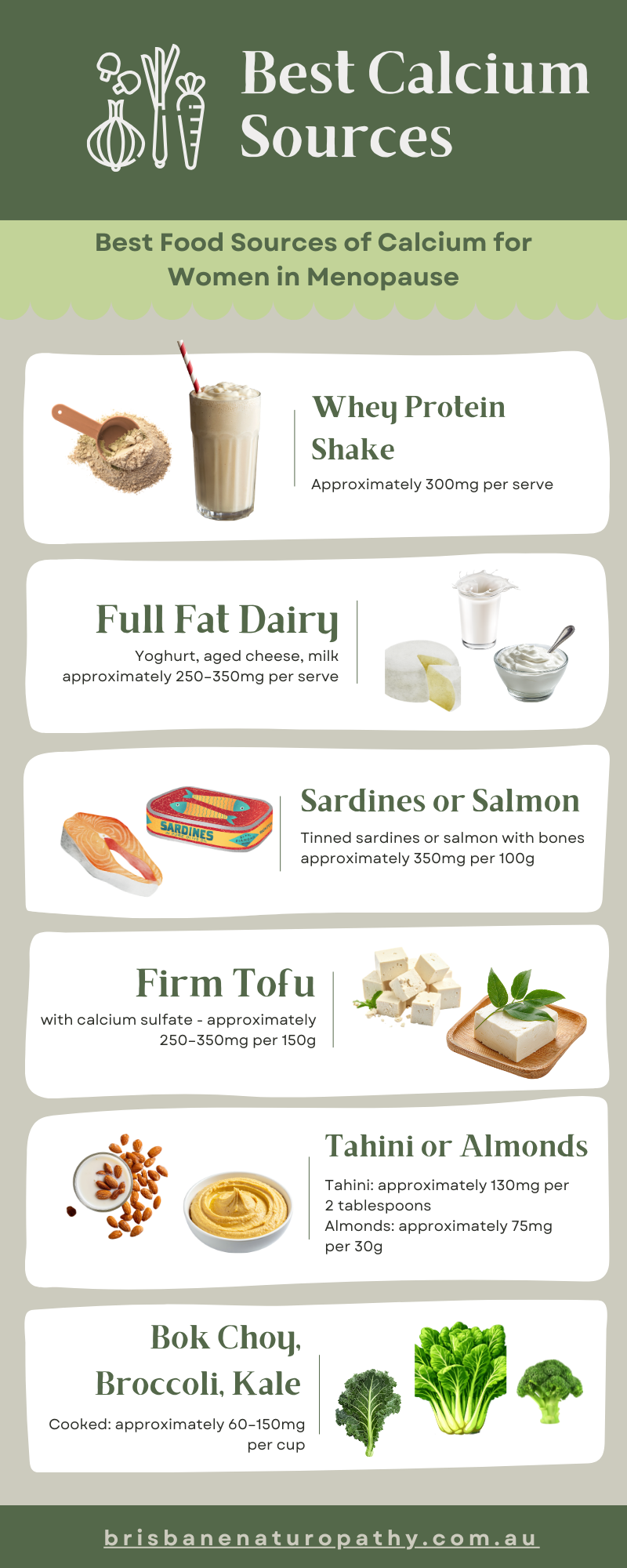
Spreading your calcium intake across two to three meals throughout the day, rather than consuming it all in one sitting, significantly improves absorption.
The gut can only absorb roughly 500mg of calcium at a time.
Calcium Supplementation: When and How
Supplements are only recommended to bridge genuine dietary gaps, but form and timing matter. Avoid taking calcium supplements at the same time as iron or zinc, as these minerals compete for absorption.
Lifestyle and Mind-Body Support
Gut Health — A Two-Way Relationship With Calcium
The relationship between calcium and gut health is bidirectional and underappreciated. When calcium intake is inadequate, the body responds by widening the spaces between enterocytes (the cells lining the small intestine) to increase what is called paracellular absorption, essentially forcing the gut to become more permeable to absorb more calcium. This is, in effect, a physiologically induced form of intestinal permeability, commonly referred to as leaky gut.
Elevated PTH — the hallmark of inadequate calcium intake — is in fact one of the primary drivers of gastrointestinal symptoms in clinical practice. Bloating, irregular bowel habits, and gut discomfort are among the presentations that warrant investigation of calcium status.
Sleep, Stress, and the Cortisol Connection
PTH and cortisol follow overlapping circadian rhythms, with both tending to peak in the early morning hours. Chronic stress, which elevates cortisol, can exacerbate the effects of elevated PTH on bone resorption. Managing stress is therefore a genuine component of any bone health strategy for women in perimenopause and menopause, not a lifestyle suggestion.
Prioritising 7–9 hours of quality sleep per night supports healthy PTH rhythmicity. Regular weight-bearing exercise, walking, and strength training, stimulate bone remodelling and remains one of the most evidence-backed interventions for bone density in menopausal women.
When to Seek Professional Guidance From a Naturopath
Consider a naturopathic consultation if you are experiencing any of the following:
Perimenopause or menopause, when oestrogen decline significantly accelerates bone resorption
Long-term use of medications that affect calcium metabolism, including corticosteroids, proton pump inhibitors, or anticonvulsants
Persistent gut symptoms including bloating, loose stools, or abdominal discomfort
History of osteopenia or osteoporosis, or a family history of bone fragility fractures
Restricted dietary patterns — including veganism or very low calorie diets, that may limit calcium intake
Practising intermittent fasting or time-restricted eating and wanting to understand the impact on your bone health
The Bottom Line
Calcium is far more than a bone mineral. It is a nutrient with its own circadian rhythm, a close relationship with your gut microbiome, and a hormonal regulatory system that responds, within seconds, to fluctuations in intake.
For women navigating perimenopause and menopause in Brisbane and across Queensland, understanding this complexity empowers genuinely meaningful change, and helps you recognise when symptoms might point to an underlying calcium imbalance worth investigating.
Book a naturopathic consultation at Brisbane Naturopathy & Iridology Clinic today.
References
El-Hajj Fuleihan, G., et al. (1997). The parathyroid hormone circadian rhythm is truly endogenous. Journal of Clinical Endocrinology and Metabolism, 82(1), 281–286.
Ma, J., Johns, R. A., & Stafford, R. S. (2007). Americans are not meeting current calcium recommendations. American Journal of Clinical Nutrition, 85(5), 1361–1366.
International Osteoporosis Foundation. (2015). More calcium needed in diets: Study. IOF Press Release.
Kopic, S., & Geibel, J. P. (2013). Gastric acid, calcium absorption, and their impact on bone health. Physiological Reviews, 93(1), 189–268.
Lee, A. M., et al. (2014). Adequate dietary vitamin D and calcium are both required to reduce bone turnover. Journal of Steroid Biochemistry and Molecular Biology, 144(Pt A), 159–162.
Calvo, M. S., et al. (1991). Circadian variation in ionized calcium and intact parathyroid hormone. Journal of Clinical Endocrinology and Metabolism, 72(1), 69–76.